
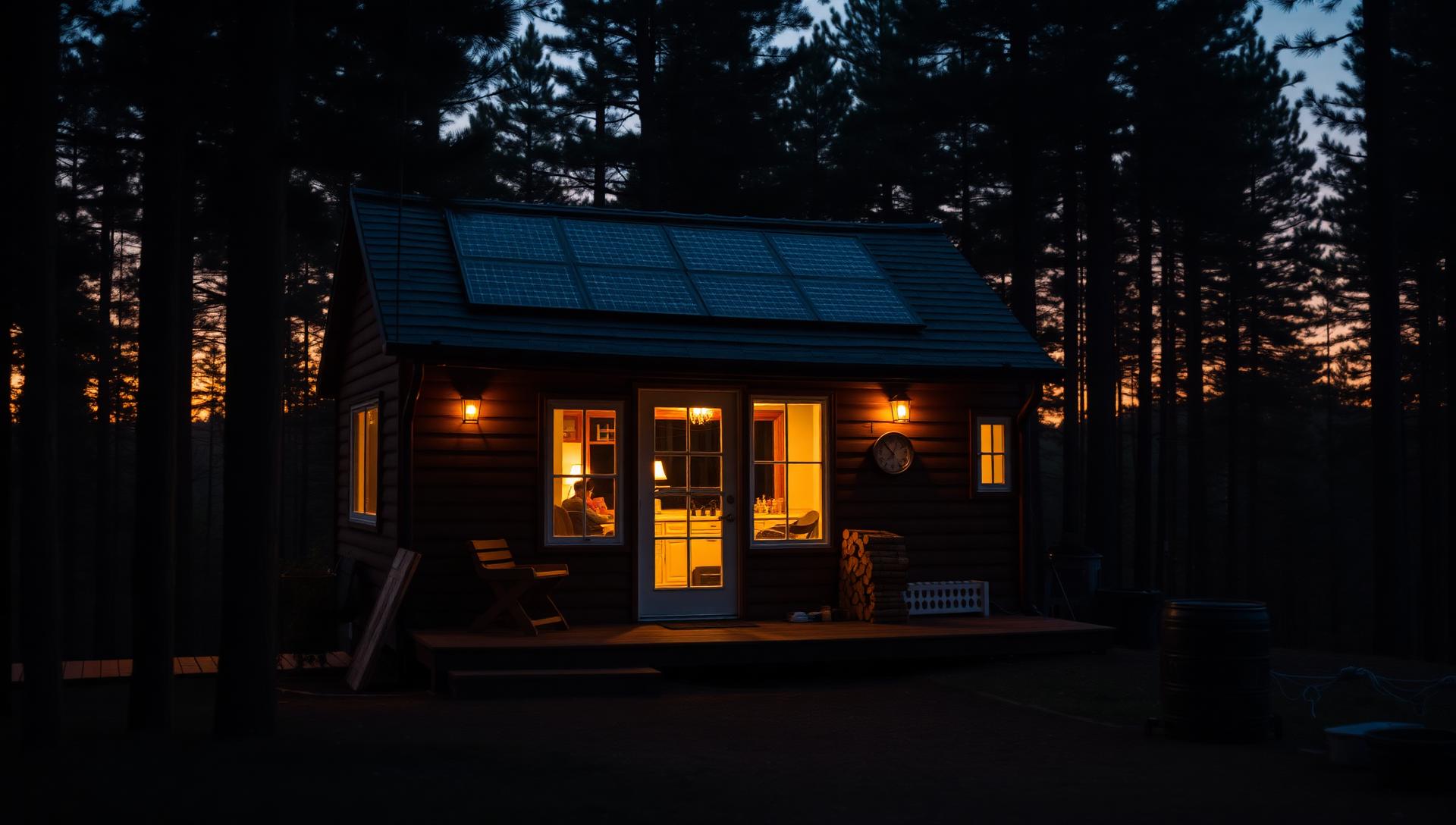
Off-Grid Cabin Essentials
What You Actually Need (and What Experienced Owners Wish They'd Known)
The dream of owning an off-grid cabin often starts with images of quiet mornings, fresh air, and escaping the noise of everyday life.
The reality is just as rewarding — but only if you've planned for the basics.
Living off-grid isn't about roughing it. It's about building systems that continue working when utilities aren't available.
Experienced cabin owners tend to discover the same lesson over and over: convenience comes from preparation, not from improvisation.
Whether your goal is a weekend retreat or a full-time off-grid home, these are the essentials worth prioritizing first.
01
Start With Shelter
The cabin itself matters more than any gadget you'll bolt onto it. A well-built shell is what makes every other system easier — a leaky roof or drafty window will drain your batteries, your firewood, and your patience faster than any missing accessory.
Good insulation
Walls, floor, and ceiling — not just walls
Weatherproof windows
Double-pane, sealed, operable
Quality roof
Metal or standing seam holds up best
Ventilation
Prevents mold and condensation
Moisture management
Vapor barriers and proper drainage
Rodent prevention
Seal every gap larger than a pencil
“A comfortable cabin starts with good construction — not expensive gear.”
02
Reliable Power Comes First
Power off-grid is never one thing. It's a stack — a primary source you use every day, a backup for the days it fails, and an emergency layer for when both are down. Redundancy is what turns a fragile setup into a dependable one.
Solar panels
Silent, low-maintenance, ideal primary source in most climates.
Battery storage
Lithium (LiFePO4) has become the practical standard.
Portable power stations
Grab-and-go layer for outages and remote work.
Backup generators
Propane or dual-fuel for long, gray weeks.
Fuel storage
Stabilized, rotated, and stored away from the cabin.
Primary
Solar
Backup
Generator
Emergency
Portable battery
A single failure point is the most common mistake new owners make. Two mediocre power sources will serve you better than one perfect one.
03
Water Is a System
Water is easy to underestimate. You need to collect it, store it, move it, and clean it — and storing water is only half the equation. A cistern with no filter is a liability; a filter with no storage is a gadget.
Rainwater collection
Gutters, first-flush, screened intake
Storage tanks
Sized for your longest dry stretch
Well systems
With a manual or DC pump option
Portable filters
Sawyer, Katadyn, LifeStraw — always on hand
Gravity filters
Berkey-style for daily kitchen use
Water testing
Annually, plus after major changes
“You aren't off-grid until you can produce, store, and clean your own water.”
04
Heat Is More Important Than Electricity
Warmth is a survival requirement. Electricity is a convenience. In a cold snap you can live without lights for a week — you can't live without heat for a night. Prioritize accordingly.
Wood stove
The most reliable heat source ever built. Works without power.
Chimney maintenance
Sweep annually. Creosote fires end cabins.
Firewood storage
Covered, off the ground, seasoned at least a year.
Carbon monoxide detectors
Battery-powered, one per level.
Backup heating
Propane heater or diesel stove for shoulder seasons.
05
Food Storage That Actually Works
Off-grid food storage isn't about hoarding — it's about rotation. A well-organized pantry with thirty days of familiar meals beats a basement full of buckets you'll never open.
Pantry organization
Labels, dates, line of sight
Vacuum sealing
Extends dry goods dramatically
Freezers
Chest freezers hold cold far longer than uprights
Root cellars
Free refrigeration for roots and squash
Rodent-proof containers
Glass, metal, or heavy plastic — never bags
Food rotation
First in, first out. Always.
06
Lighting
Layered lighting is the difference between a cozy cabin and a dim one. Natural light does most of the daytime work; a few well-placed rechargeables handle the rest.
- Design for natural light first
- Rechargeable lanterns for common rooms
- Headlamps for every adult and child
- Battery backups sized to your fixtures
- Candles as emergency backup only
07
Communication
Off-grid doesn't mean disconnected. It means choosing your channels deliberately — and having more than one that works when the nearest cell tower doesn't.
NOAA weather radio
The first alert layer. Works without cell service.
Satellite communicator
Garmin inReach or equivalent for true remote areas.
GMRS radios
Family communication around and beyond the property.
Offline maps
Downloaded, laminated, and stored in the truck.
Emergency contacts
Printed. Not just on a phone.
08
Tools Worth Buying Once
Cheap tools fail on the coldest day of the year. Buy the good version once — you'll still be using it in twenty years.
Chainsaw
A quality mid-size saw with two chains and proper PPE.
Quality axe
Hults Bruk, Council Tool — anything hand-forged.
Splitting maul
8 lb head. Splits what a hatchet can't.
Shovel
A round point and a flat point. Both fiberglass.
Wheelbarrow
Contractor grade, single-tire for tight paths.
Tool kit
SAE and metric, in a rolling box that stays at the cabin.
Ladder
Extension plus a small step ladder for interior work.
Cordless drill
Two batteries. Impact driver bundle is worth it.
09
Things New Cabin Owners Often Forget
Almost every cabin owner discovers the same short list — often at the least convenient moment. Stock these now and thank yourself later.
10
Seasonal Maintenance Checklist
Print this. Tape it inside a cabinet door. Run through it every quarter.
Spring
- Inspect roof
- Clean gutters
- Test batteries
Summer
- Stack firewood
- Inspect solar panels
- Check water system
Fall
- Clean chimney
- Winterize plumbing
- Service generator
Winter
- Monitor snow loads
- Check batteries
- Inspect heating system
The best off-grid cabins aren't the ones with the most equipment.
They're the ones with simple systems that are maintained consistently.
11
Common Mistakes
- Buying gear before fixing the cabin
- Ignoring insulation
- Having only one source of power
- Running out of stored water
- Forgetting spare parts
- Poor food rotation
- Skipping maintenance
12
Final Thoughts
An off-grid cabin isn't built in a weekend.
It's built one dependable system at a time.
Focus first on shelter, water, heat, and power. Once those foundations are reliable, everything else becomes easier to improve over time.
The goal isn't perfection.
The goal is creating a place that's comfortable, resilient, and enjoyable in every season.
Join Apocalypse Warehouse's newsletter, The Outpost
Practical preparedness, off-grid living, gear testing, and seasonal checklists delivered weekly.
No spam. Unsubscribe anytime.