
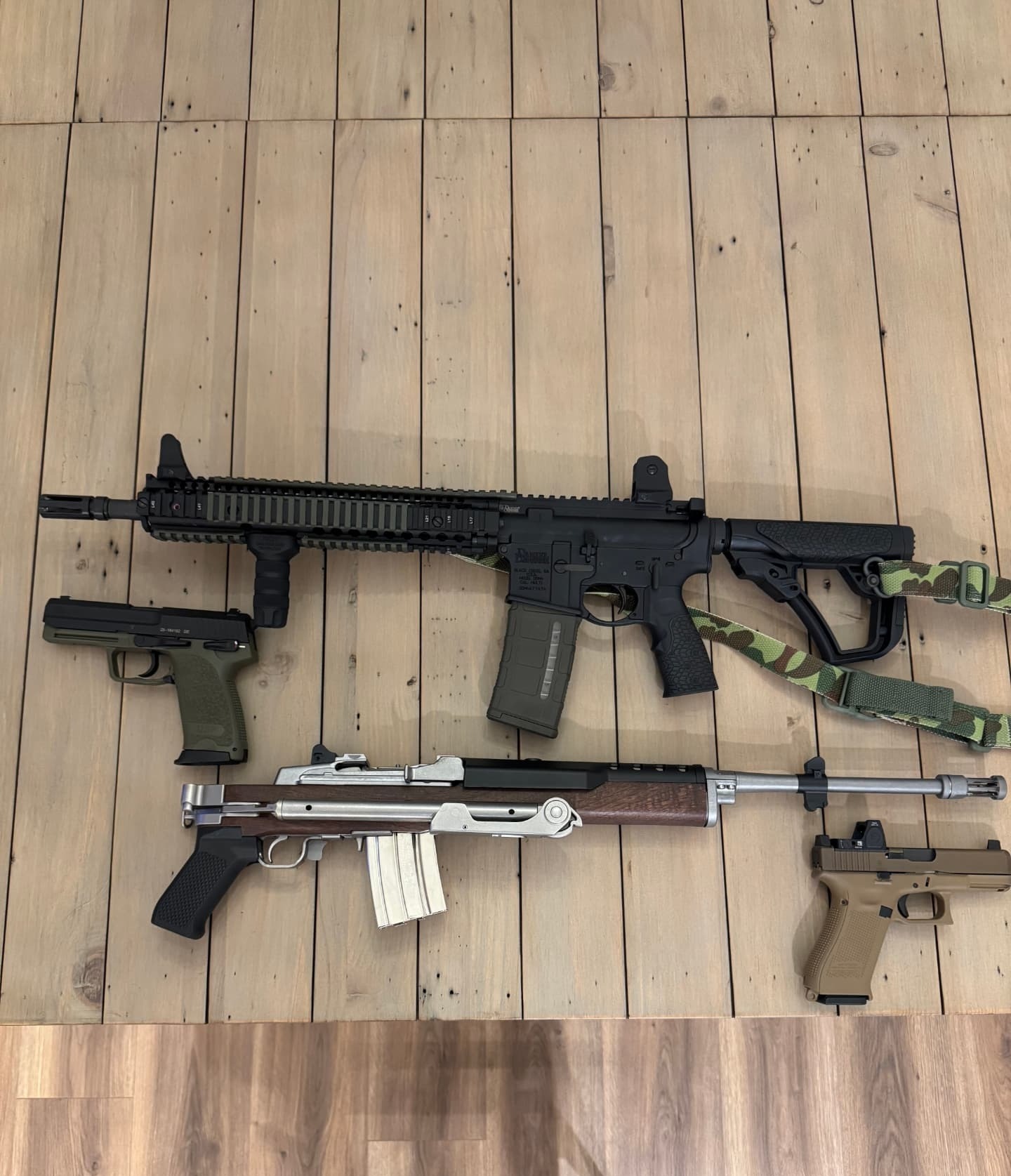
The Armory — Comparisons / Personal range evaluation
The Age-Old Question: Which Would You Rather Have in the Apocalypse? The AR-15 or the Mini-14?
Two very different approaches to the same cartridge. One is the practical choice. The other has a little more personality than it probably should.
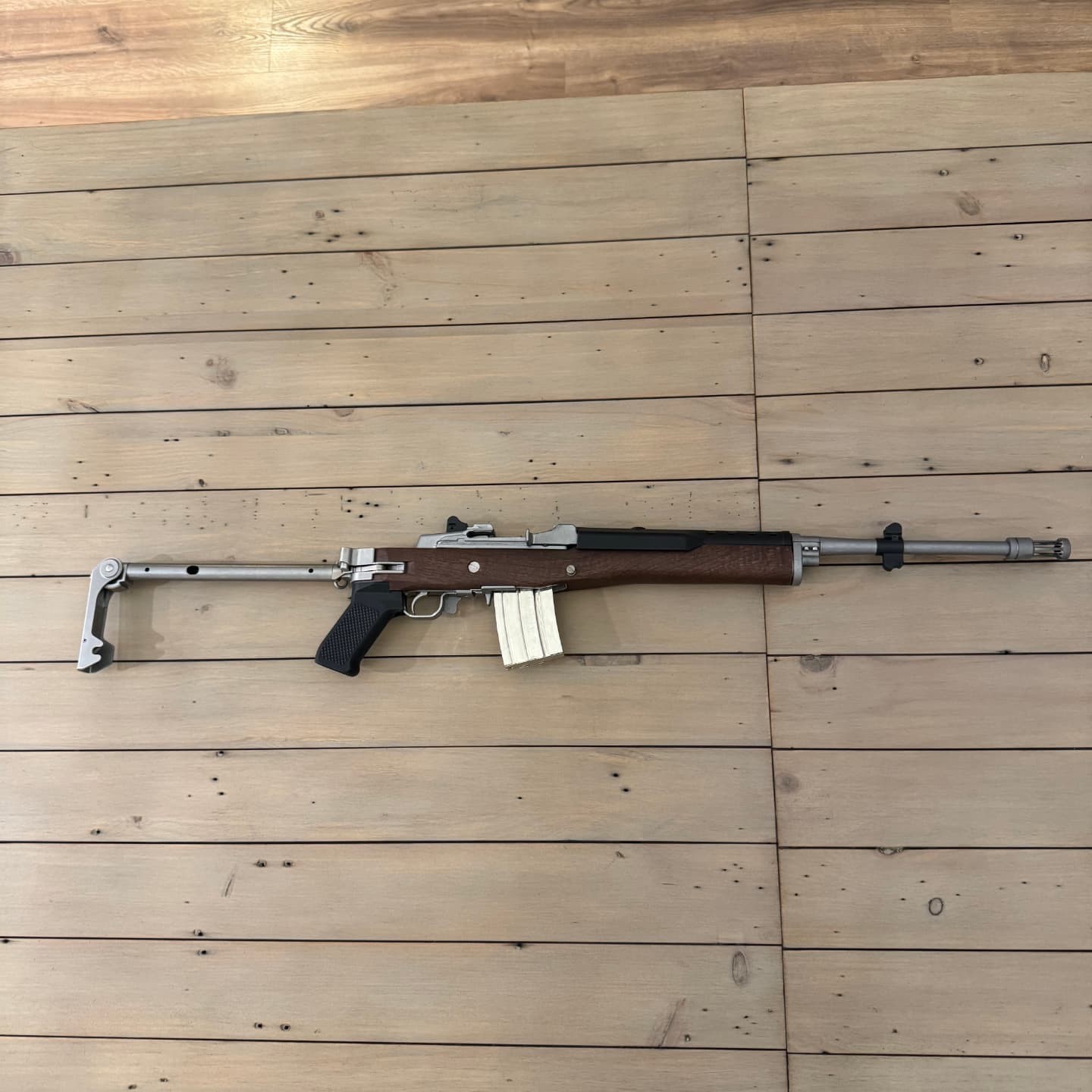
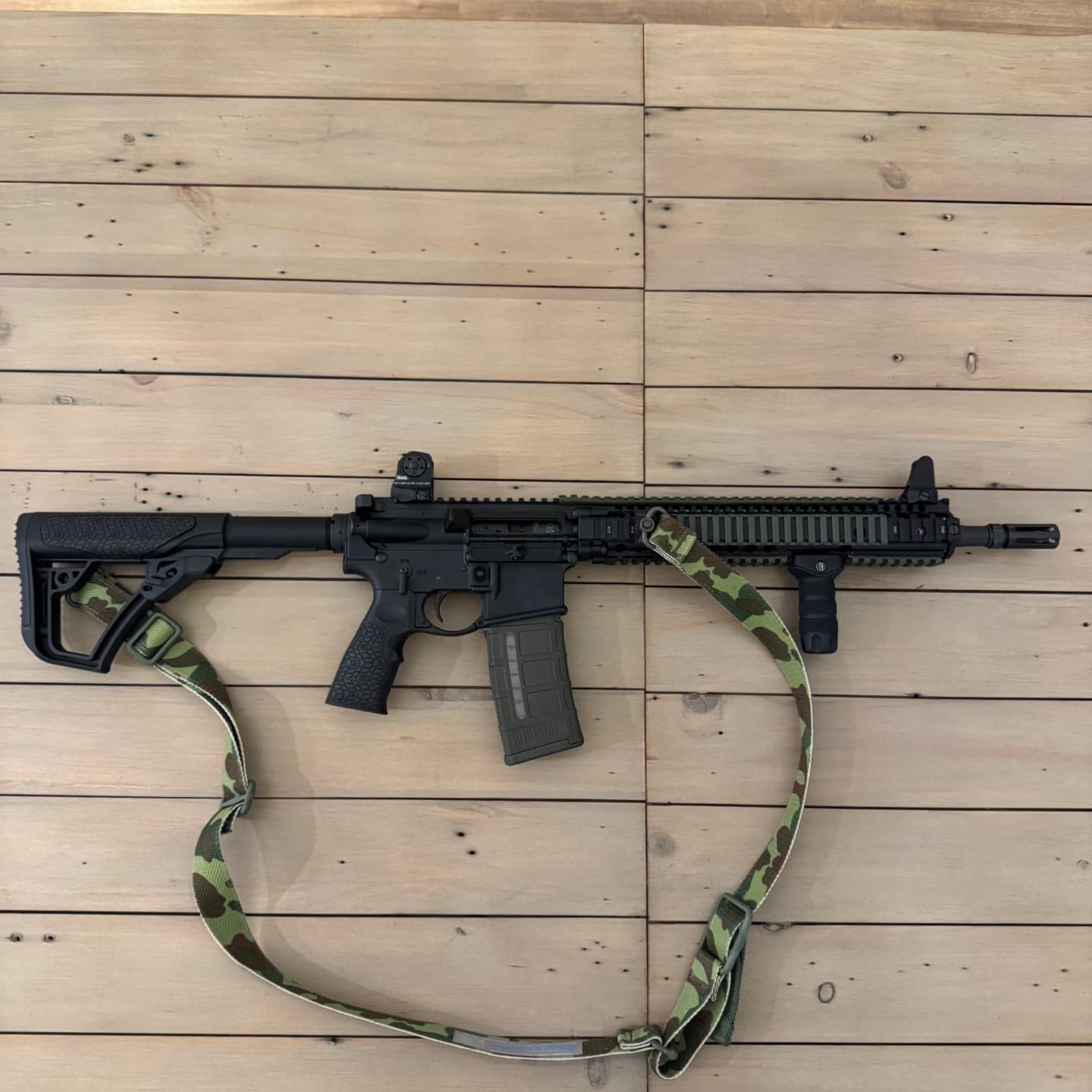
Head to head
Two rifles. Two very different personalities.
Our impressions of these two specific rifles—not a universal ranking, measured endurance test, or controlled accuracy study.
| Category | Stainless Mini-14 | Daniel Defense DDM4A1 R2 |
|---|---|---|
| Operating system | Fixed-piston | Direct impingement |
| Recoil impression | Smoother, more of a push | Snappier |
| Accuracy in this test | Wider groups | Tighter groups |
| Magazine ecosystem | Mini-14-specific | Broad .223/5.56 AR-pattern compatibility |
| Modularity | More limited | Extensive |
| Learning curve | Less intuitive to the author | More intuitive to the author |
| Author’s preference | Personal favorite | Practical choice |
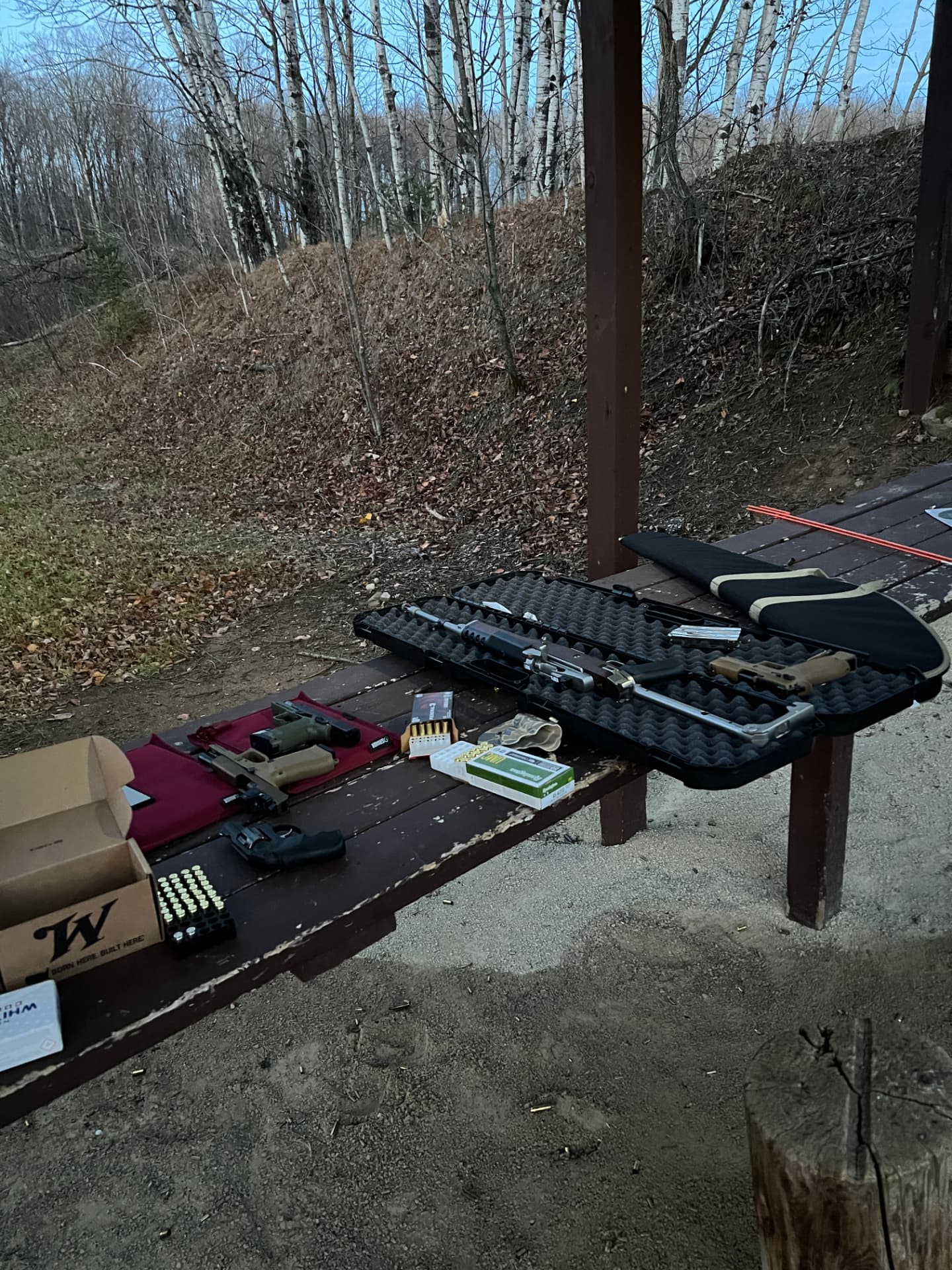
The guns used in this head-to-head test are the stainless Mini-14 with folding stock and the Daniel Defense M4A1 R2 (Picatinny supremacy).
This question has been approached scientifically down to the grain used in the bullet. People pull MOA groupings at 50–1,000 yards and everything in between trying to replicate each shot angle. I am not one of those people. You will not be one of those people in a true apocalyptic situation.
Can the gun hurl lead downrange reliably and where you're pointing? That's all I care about when considering which I'd want in my hands in a true SHTF situation.
The Reliability Debate: Piston vs. Direct Impingement
The strongest argument people make here is that the Mini-14's piston system should let it run longer between cleanings than the DDM4's direct-impingement system. That's the argument—not an endurance result from this range session.
Both rifles handled the compatible ammunition I used. I did not measure a failure threshold or test either rifle to exhaustion.
The piston essentially means the Mini-14 doesn't eat where it shits. The gas does not travel back into the bolt carrier group and receiver in the same way as a direct-impingement AR-15. This keeps the receiver cleaner with less gas-system carbon buildup.
Less gas-system fouling in the receiver does not, by itself, establish how long a particular rifle will run or how hot the whole rifle gets.
This opens up the argument time and time again that a Mini-14 can run dirty after an AR-15 might malfunction. Actual reliability depends on the rifle, ammunition, lubrication, maintenance, and conditions—not just the operating system.
The people who make this argument are the same people who argue that you can scavenge 5.56 or .223 almost anywhere because it's such a common round.
If this is the case, the counterargument needs to be made that if you can scavenge the ammo, you can certainly scavenge the cleaning essentials.
This is never considered enough, almost as though in a SHTF scenario every house and store that has 5.56 ammo will suddenly have a neon sign announcing it, but cleaning kits are suddenly nonexistent.
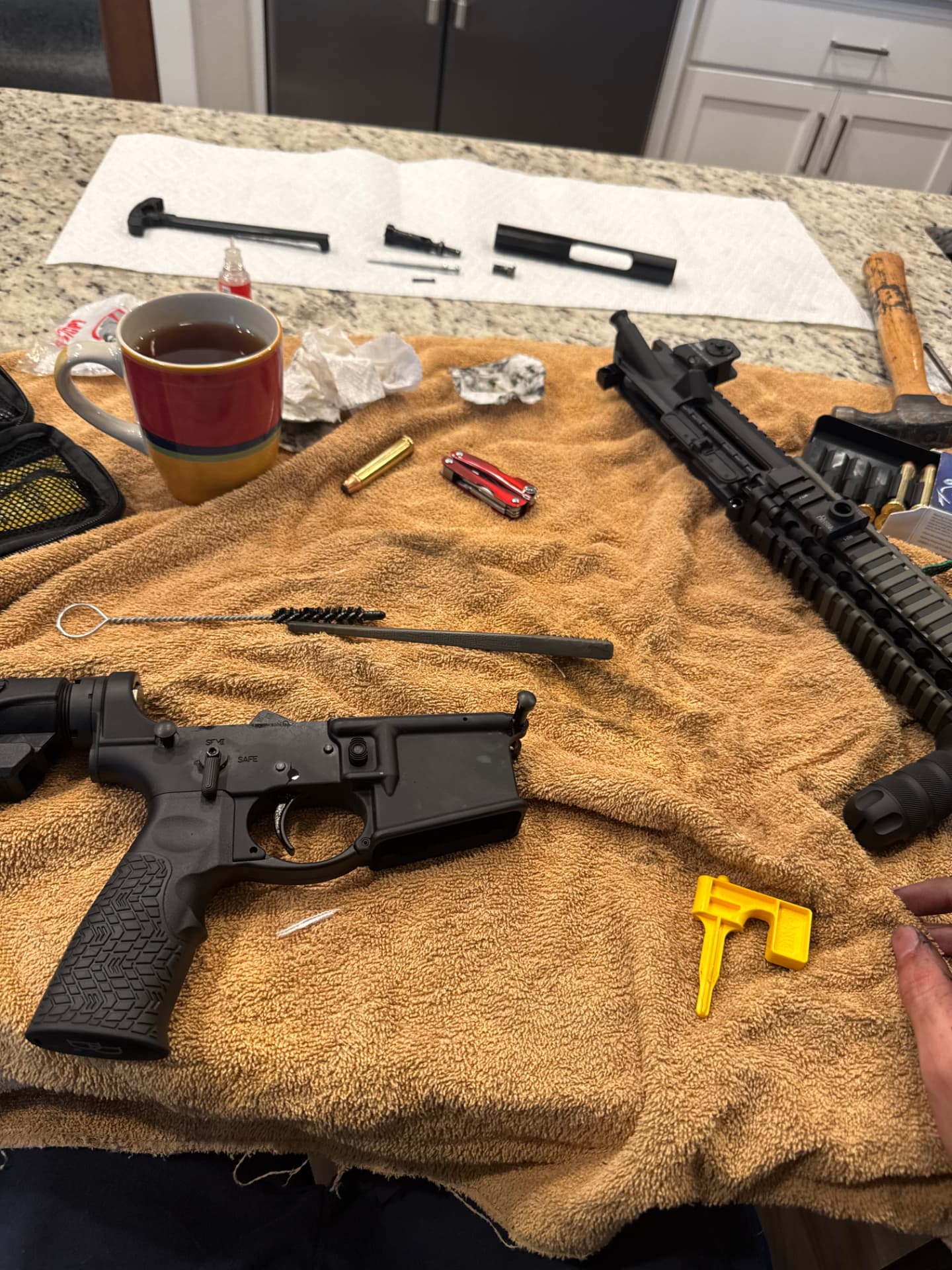
Whatever your preferred cleaning interval, both guns need proper maintenance.
For the cleaner-receiver argument, my opinion point goes to the Mini-14. But please people, clean your rifles and take care of the things that take care of you.
Ammunition: What Did We Actually Use?
Let's get into what rounds I used.
I primarily used 5.56 green tips, but I dumped those and .223 together and randomly picked them up and loaded them into mags.
Again, to truly simulate a dire SHTF scenario I want a gun that can feed anything that's stamped on the barrel.
I don't care whether it's suitable factory 5.56 or .223 from the stockpile under your uncle who "told you so"'s bed for years—as long as it is identifiable, undamaged, and approved for that specific rifle. Chamber markings and the manufacturer's manual decide compatibility; .223 and 5.56 are not universally interchangeable.
Scarcity does not change those compatibility or ammunition-condition requirements.
Recoil and Accuracy: The AR-15 Takes the Point
I found the recoil on the Mini-14 to be much smoother, while the DDM4 was snappier.
However, the accuracy of the Mini-14 was not as tight as the M4.
Did they both hit the man-sized paper target downrange at 25, 50 and 100 yards?
Yes.
While the Mini-14 isn't known for its accuracy, and some may say it's actually known for its inaccuracy, it still put lead to paper target, just not as tight as the M4 in this session.
As my cousin said:
"Looks like it still got the job done to me."
To scientifically sum that up, the Mini-14 is still an effective option at range.
However, the point goes to the AR-15.
This is based on my own experience with these two rifles, not a controlled scientific accuracy study.
The Learning Curve: The AR-15 Makes It Easy
The next thing I don't think gets talked about nearly enough is learning curve.
Can a complete newbie pick it up and be somewhat effective?
This is where we start seeing a strong deviation.
The first semi-auto rifle I ever shot was a Mini-14. In my opinion, next to the pump Remington 870, it is the best-sounding action of any gun.
The faint metallic ping upon releasing the bolt and chambering a round is pure ecstasy.
As stated earlier, shooting it feels smooth and the recoil is more of a push than a snap.
With all this being said you'd think it was a flawless first experience.
On the contrary, it was anything but.
One thing I tell people when they first shoot the Mini-14 is "you have to make it your bitch and man handle it."
What does this mean?
To put it plainly, the controls felt less forgiving to me—not that you should abuse the mechanism or ignore the manual.
All in all, its controls felt less intuitive to me as a new shooter. That is a personal learning-curve observation, not a substitute for qualified instruction.
If operating the Mini-14 is some kind of masochistic exercise to a new shooter, operating an AR-15 is a walk in the park.
Try as I might, I cannot find many redeeming qualities for the Mini-14 here.
Point to the AR-15.
Modularity: The AR-15 Wins, and It Isn't Close
Now the elephant in the room.
Modularity.
Let's just come out and say it. The Mini-14 sucks in this department.
The single most common reason law enforcement agencies dropped the Mini-14 and moved to the AR-15 platform is modularity.
The Mini-14 does not offer the same breadth of options.
You can run optics on the Mini-14, but mounting options depend on the exact model, stock, and optic. It is not an optics-free platform; it just doesn't offer the same broad accessory ecosystem as an AR-15.
But where we truly have to detract points and the Mini-14's largest complaint?
It's those awful magazines.
Proprietary to Ruger, the Mini-14 does not and cannot take standard AR mags. It takes Mini-14-specific magazines; my preference is Ruger-made magazines.
I am not inclined to gamble on cheap Mini-14 magazines. Quality and compatibility vary, so that is my preference—not a claim that every aftermarket magazine fails.
To revisit the scavenging scenario earlier, you are much more likely to find AR mags than you are Mini-14 mags.
Many standard .223/5.56 AR-15s share a broad magazine ecosystem. That does not mean every AR-pattern rifle, caliber, magazine, upper, or lower is interchangeable; manufacturer specifications still control compatibility.
The modularity is, dare we say, almost unlimited for an AR-15.
The size of that parts and support ecosystem is another practical advantage. Compatibility still needs to be checked rather than assumed.
The AR-15 gets the point.
The Final Verdict: Give Me the Mini-14
So what would I want in my hands in a true SHTF scenario?

Honestly, give me my Mini-14 stainless folding because I pity the fool who tries me.
Did you really think you'd make it through this writeup without an A-Team reference?
It's a truly goofy gun you have to shoot to understand.
The reasonable, intelligent choice would be the AR-15 for all the above statements listed.
But those who love the Mini-14 just get it.
You can run it hard, it likes to be abused, and I'll stockpile Ruger-made mags for it.
What should YOU have in your hands?
Go to the range and see what you like. Make a list of what's important to you and TRAIN TRAIN TRAIN on what you decide on.
The most effective gun is the one you train on and train consistently on.
The final verdict
The practical choice
Daniel Defense DDM4A1 R2 / AR-15
The ecosystem, the modularity, and the author’s accuracy and handling impressions.
The personal favorite
Stainless Ruger Mini-14 with folding stock
The one with more personality than it probably should. Obviously.
Firearms are dangerous and require responsible ownership, safe handling, and regular maintenance. Always follow the manufacturer's instructions, use appropriate ammunition, comply with applicable federal, state, and local laws, and seek qualified instruction. This article reflects the author's personal experience and opinions regarding two specific rifles. It is not a controlled scientific evaluation or legal advice.
Back to The Armory